
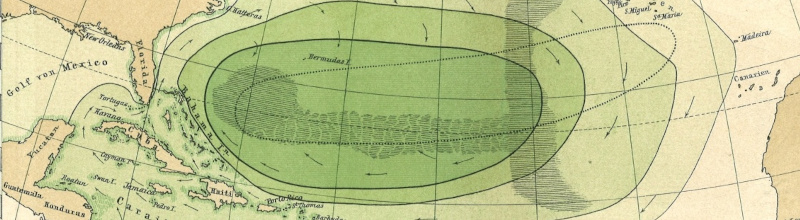
 La mer des Sargasses dans l'Atlantique nord, Cartographiée d'après Otto Krümmel 1854-1912
Edgwidge Danticat, in her introduction, clarifies that Wide Sargasso Sea is based on Jane Eyre, but that it is not mere fan fiction. There are many reasons: Jean Rhys brings us to a different time and place (post-emancipation Jamaica and Dominica), gives depth to the character of Bertha, describes the initiating reason for and the dyfunction of Rochester and Bertha’s relationship, and introduces a set of characters that define the setting and influence Bertha and Rochester’s relationship.
Early in the story, Rhys foreshadows Antoinette’s (Bertha’s) death and gives an explanation for it. Told from Antoinette’s perspective:
Our parrot was called Coco, a green parrot. He didn’t talk very well, he could say Qui est là? Qui est là? and answer himself Ché Coco, Ché Coco. After Mr Mason clipped his wings he grew very bad tempered, and though he would sit quietly on my mother’s shoulder, he darted at everyone who came near her and pecked their feet.
. . . .
I shut my eyes and waited. Mr Mason stopped swearing and began to pray in a loud pious voice. The prayer ended, ‘May Almighty God defend us!’ And God who is indeed mysterious, who had made no sign when they burned Pierre as he slept - not a clap of thunder, not a flash of lightning - mysterious God heard Mr Mason at once and answered him. The yells stopped.
I opened my eyes, everybody was looking up and pointing at Coco on the glacis railings with his feathers alight. He made an effort to fly down but his clipped wings failed him and he fell screeching. He was all on fire.
I began to cry.
The story is told in two first-person perspectives: one is Antoinette’s (Bertha’s), the other Rochester’s. This enabled Rhys to describe the inner turmoil of both, and how it contributed to Antoinette’s self-destruction. The story reaches its climax when Christophine confronts Rochester. Their conversation draws out Rochester as aware that Antoinette loves him (or needs his love?) and that he chooses money rather than letting her go and possibly living a better life and saving herself. This is the connection to clipped wings that resulted in the death of Coco the parrot. The men both took away the ability to leave and were unwilling to help Coco/Antoinette.
Told from Rochester’s perspective, the conversation shows Rochester avoid the challenge to either love Antoinette or leave her:
‘You are a damn hard man for a young man….I tell her so. I warn her. I say this is not a man who will help you when he sees you break up….I know that girl. She will never ask you for love again, she will die first. But I Christophine I beg you. She love you so much. She thirsty for you. Wait, and perhaps you can love her again. A little, like she say. A little. Like you can love.’
Why, she wanted to know, could I not return half of Antoinette’s dowry and leave the island– ’leave the West Indies if you don’t want her no more’….Perhaps because I was so quiet and composed she added maliciously, ‘She marry with someone else. She forget about you and live happy.’
A pang of rage and jealousy shot through me then. Oh no, she won’t forget. I laughed.
‘You laugh at me? Why you laugh at me?’
‘Of course I laugh at you - you ridiculous old woman. I don’t mean to discuss my affairs with you any longer….I’ve listened to all you have to say and I don’t believe you.’
