
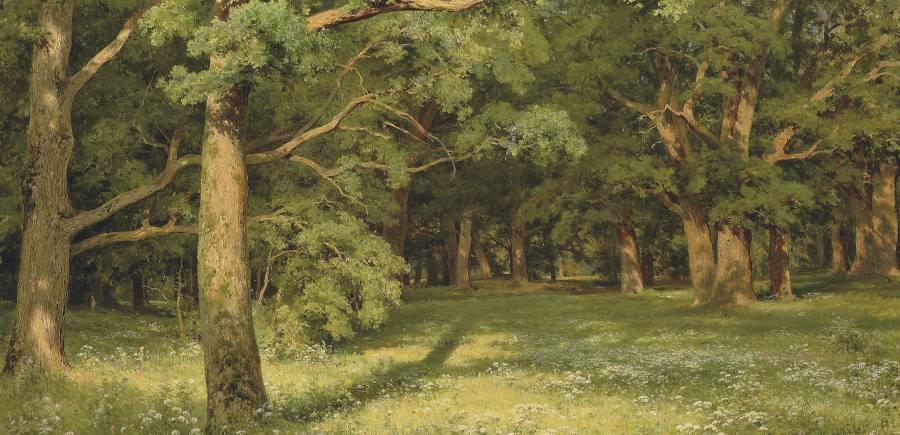
 The Forest Clearing by Ivan Shiskin, 1896
Early in the story, we read about Denver’s ring of boxwood bushes, which help her feel safe. Later, we learn that Baby Suggs’s “unchurched sermons” also took place in a similar hollowed-out part of nature, a clearing in the forest.
Back beyond 124 was a narrow field that stopped itself at a wood. On the yonder side of these woods, a stream. In these woods, between the field and the stream, hidden by post oaks, five boxwood bushes, planted in a ring, had started stretching toward each other four feet off the ground to form a round, empty room seven feet high, its walls fifty inches of murmuring leaves. Bent low, Denver could crawl into this room, and once there she could stand all the way up in emerald light. . . .Veiled and protected by the live green walls, she felt ripe and clear, and salvation was as easy as a wish. (Act I, p34)
When warm weather came, Baby Suggs, holy, followed by every black man, woman and child who could make it through, took her great heart to the Clearing—a wide-open place cut deep in the woods nobody knew for what at the end of a path known only to deer and whoever cleared the land in the first place. In the heat of every Saturday afternoon, she sat in the clearing while the people waited among the trees. . . .She told them that the only grace they could have was the grace they could imagine. That if they could not see it, they would not have it.
There’s an article by the Northwest Natural Resource Group that helps provide subtext for a gathering in a forest clearing:
Avalanches tend to create clearings much larger than an acre or two. The same is true of forest fires. Then there are volcanic eruptions, which can clear vast numbers of trees with winds of hundreds of miles per hour, and also with fire, deep ash fall, and lahars (violent mud- and debris-flows that sometimes result from volcanic activity). Heavy rains can result in flooding rivers that can carry away trees along river banks and in river floodplains. Landslides, occasional hurricane-strength winds that sweep through our region, and large-scale disease and insect damage can also create larger-scale forest clearings.
Diseases such as laminated root rot, a fungal disease that affects most conifers in the Northwest, can create small clearings in the forest. The fungus is spread by direct root contact between an infected tree and a non-infected tree. So in a stand of trees such as Douglas firs, an infected tree will eventually be surrounded by a circle of other trees that it has infected. While some trees can live for many years after being infected, they are gradually weakened by the fungus and become more susceptible to being blown down by strong winds. So, over time, laminated root rot can cause small clearings or partial-clearings to open up in the forest.
Even the healthiest tree eventually ages and dies. In an old-growth forest in the Pacific Northwest, when one of the great conifers falls—or when, as often happens, two or three great trees growing in a close clump all go down together—a very small clearing is created. At the foot of the fallen giant will often be found tiny trees (especially Western hemlock) that may look like very young trees, but which may have lived in the shade for decades in a state of arrested growth as they awaited the opportunity to take the place of one of the mature trees. When sunlight at last penetrates through the canopy, the waiting little trees put on a rapid spurt of growth as they race to fill the vacancy. The death of a giant tree becomes the opportunity for renewed life for these trees.
Whether a clearing in a forest is large or small, the net result of its creation is the same: new opportunities for both plants and animals.
References
