
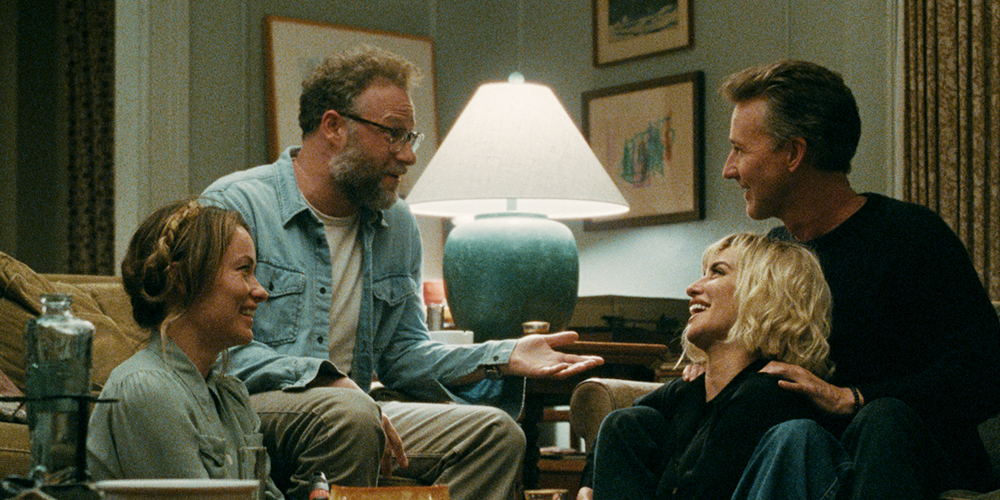
An Oscar Wilde quote setting apart love and marriage opens The Invite, a dark comedy about relationships directed by Olivia Wilde (no relationship other than admiration). The love/marriage distinction is quickly demonstrated. Seth Rogen and Olivia Wilde play Joe and Angela, a San Francisco couple whose interactions are sniping and dismissive. Angela has invited over the couple from upstairs, played by Edward Norton and Penélope Cruz. What plays out is like Who’s Afraid of Virginia Woolf?, if the visiting couple were not only happier, but more secure, than their hosts.
The movie’s marketing has done an admirable job of leaving plot and story unclear. Knowing little as a viewer is good, given that most of the character turns are surprises. Like Virginia Woolf, this is a four-person ensemble piece and it allows time for character dynamics in every direction. As each character interacts, they reach new levels of understanding about themselves and the others. What drives tension is not just commonalities and disagreements, but also that not all characters begin or end on equal footing. The story puts forth a clear philosophy of behaviors that are more healthy or less.
There’s an element of relationship attachment styles being depicted in The Invite. Fans of Levine and Heller’s Attached or Sue Johnson’s Hold Me Tight will have a field day analyzing the characters and their impact on each other. One of the characters is avoidant, one is anxious, one clearly secure, another trending secure. The tension builds as their styles are tested. The setting is San Francisco and, beyond their interactions, the material concerns of the characters demonstrate their states of synchrony or tension. There’s an extended riff on rugs and other furnishings. At one point, a character says pointedly, “This is an old apartment. Not a lot of heat.”
All of this is brought together by exceptional performances from Wilde, Rogen, Cruz, and Norton. Each plays a type to start, but each character experiences a revelation during the evening, and each steps into a variety of emotions. Their impact on each other is convincing and lands an emotional punch.
The one sin is that the story resolves too neatly. If attachment styles are what makes the movie resonate, then readers of attachment theory may be skeptical of the outcome. But the movie’s achievement is in drawing out the pattern of platonic, sexual, and quasi-sexual relationship interactions with clarity and wit. A strong recommendation for the comedy, the performances, and the relationship commentary.
