
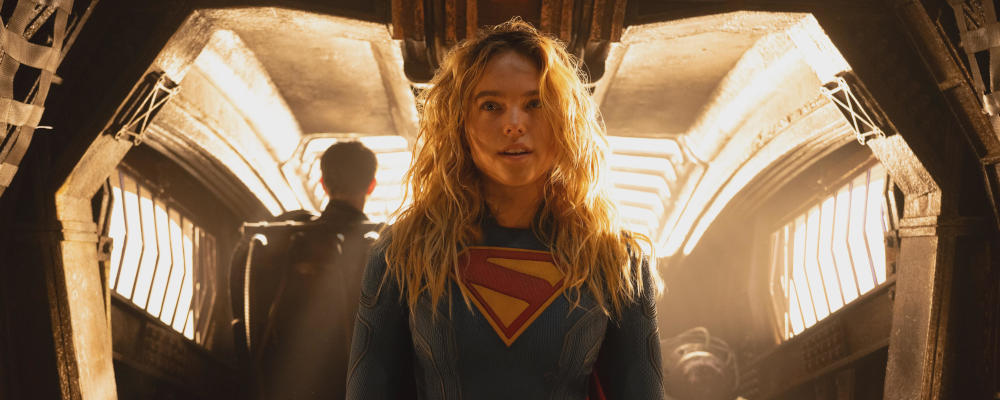
The comic book character Kara-El, aka Supergirl, comes to Earth from the planet Krypton. Like her cousin, Superman, she gets extraordinary strength, the ability to fly, and near-invincibility from our planet’s yellow sun.
Unlike her cousin, there have been few screen adaptations of the character. The most widely praised is a CW television show. The last feature film was 42 years ago, starring Helen Slater, Faye Dunaway, Mia Farrow, and Peter O’ Toole. It was widely panned for its camp and storytelling, earning two Razzie nominations. It also hasn’t aged well: the leads fight over a MacGuffin and a man. The low returns prompted the Salkinds to sell their rights to the Super-franchise, man and girl.
The character returned to the big screen this year with DC’s Gunn/Safran universe. In it, Supergirl is adrift in an alcoholic nihilism, partying on different planets, struggling to cope with the loss of her family and her world. The movie explains why this affects her and not her cousin: she grew up on the remains of Krypton and knew her biological parents, whereas her cousin didn’t.
On one of Supergirl’s inter-planetary party escapades, a space gang called the Brigands poisons Krypto, her dog. She must find the Brigands and get the antidote. On the same planet, the Brigands murder a swordsmith and his family, leaving only his teenage daughter alive. The girl sets out with a sword for revenge. (She seems to be modeled on a certain Spaniard, even regularly reciting her revenge speech.) Supergirl and the teenager embark on a search for the Brigands and their leader, named Krem of the Yellow Hills.
The writing challenge of Super-Kryptonian stories is they need a believable problem for their near-omnipotent protagonists. Supergirl’s space thugs aren’t powerful enough to oppose a Kryptonian, so the movie uses power-robbing situations to hamper its hero. Some were natural, like needing a yellow sun. Some were crafted by chief antagonist Krem. The problem is that we’re given no reason to believe Krem is capable of meeting a superperson, finding their weaknesses, and exploiting them in the story’s short timeframe. Krem gives off zero Lex Luthor vibes. In fact, we’re given no information about Krem’s powers at all. In one scene, he stops a falling tank with one hand. Other times, he moves as though he’s stuck in stiff armor.
Other characters are also thin or inconsistent. Ruthye, the teenager seeking revenge, operates more as plot device than character. We meet her family briefly, and we never know her connection to them well enough to feel Ruthye’s desire for revenge. Lobo (Jason Momoa) is underwritten too. Known in the comics as either villain or agent of chaos, the movie introduces him as dangerous and unpredictable, but then makes him a largely benign occasional helper, with the vibe of a grumpy uncle. Even Krypto the dog, whose poisoning is the inciting incident, seems like an underwhelming relationship for Kara-El. There’s no urgent interdependence as shown in the opening scene of Superman (2025). A brief flashback of Kara-el finding Krypto and a few expository statements are the only indication we get of a feeling deeper than cohabitation.
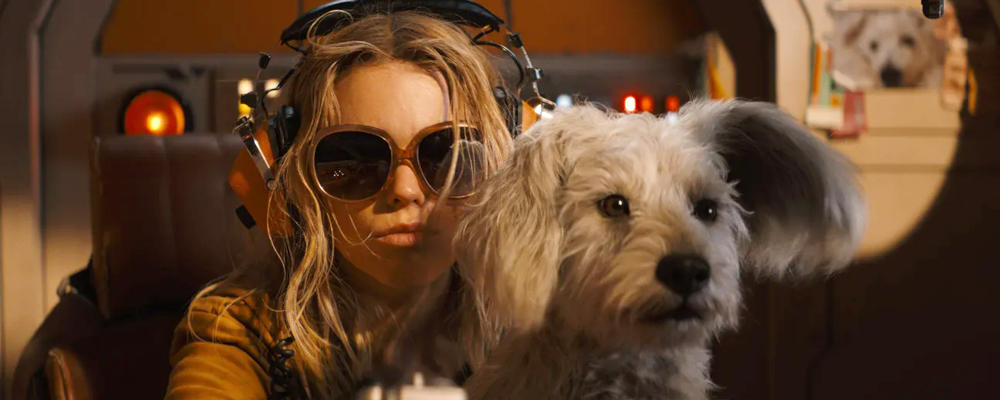 Murderous revenge requires more than cuteness. Ask John Wick.
Supergirl also fell into the origin-story trap, pausing mid-story to tell about the end of the planet Krypton, how Kara-El was sent to Earth, and how she felt there. The intent is to show, not tell, why she feels unmoored. But this far in, the story has already shown us an isolated woman whose only companion is a dog, one who parties all the time and avoids her only family. Krypton is a digression that stalls the narrative without adding to the character.
Milly Alcock’s performance fully justifies her selection. She aptly delivered the pathos of Supergirl’s party addiction, a reluctance in taking any responsibility, her sadness at losing her world, and her disdain for all the remaining worlds. She also delivered the Kryptonian fictional language as smoothly as she drops the American English punchlines (Alcock is Australian). It’s clear that Gunn/Safran want their DC heroes with human-relatable personality flaws, like the new Superman’s difficulties in thinking ahead. Alcock gets it and delivers a believably imperfect Supergirl. This story may not have done the character justice, but Alcock delivered a more multi-faceted Supergirl than any other on film, and makes it worth watching.
Supergirl doesn’t deserve the level of negativity it has received. Everything described here put it on par with 80% of the MCU and the entire DCEU. Attempts to sink this movie are also short-sighted, given that studio leads like Gunn and Safran are thinking of 10-year returns. As an example, the Popcornmeter ratings for the first Captain America and Thor movies are 75-76%. Iron Man (2008) rated higher at 91%. Similarly, Supergirl currently stands at 76%, Superman (2025) is at 90%. These first character movies serve as tests for the strategy. Studios then create ensembles with the highest-performing characters at center, surrounded by other likable characters.
In that light, Supergirl did just fine and the character will be an entertaining and profitable part of the Gunn/Safran DC universe.
