
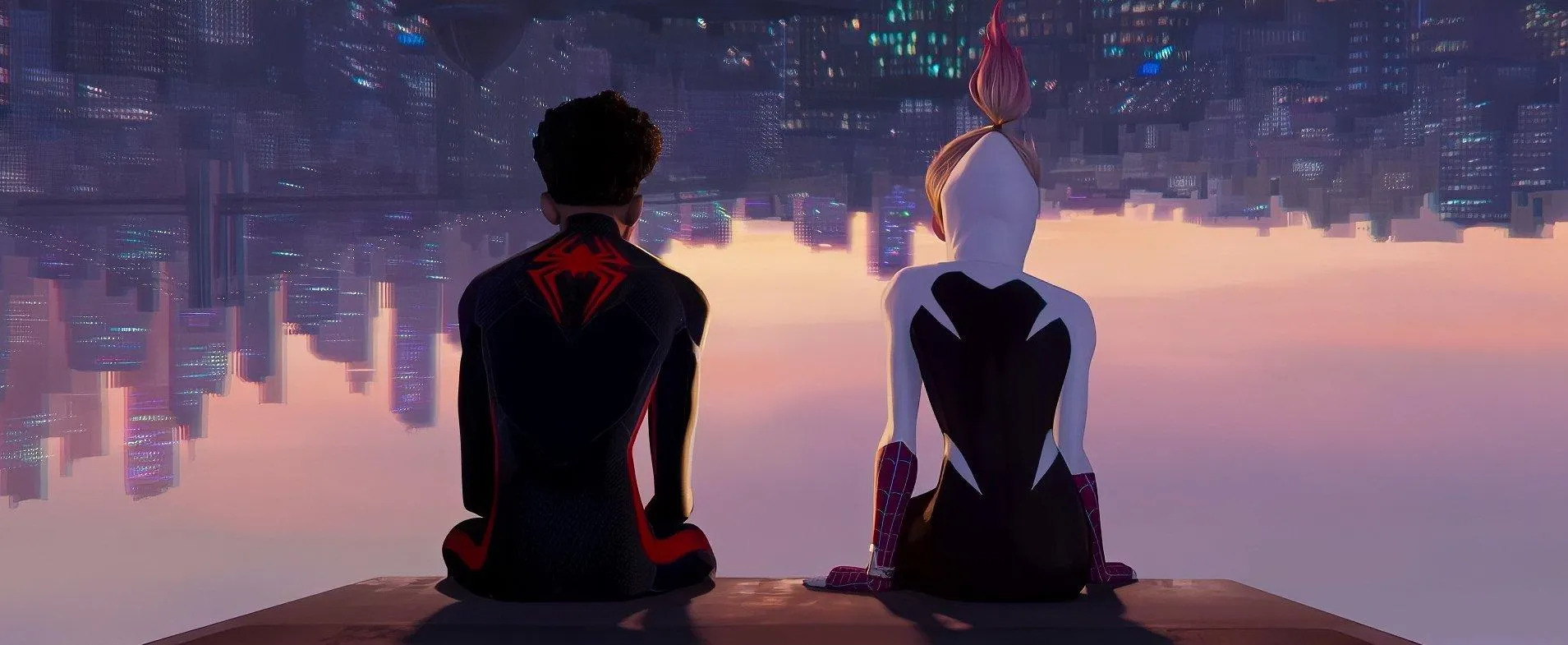
There’s not much I can add to the heap of well-deserved praise, so this is a collection of excerpts describing the animation techniques.
Mixed styles
Spider-Man: Across the Spider-Verse features six different animation styles, all of which are combined to create several characters and locations.
Stepped animation
The artists made a bigger decision to break with the way most computer-animated motion is achieved. Usually movements are created by advancing the image — say, a character raising his arm — in each frame, 24 times per second. It’s called “animating on one’s.” The resulting motion is fluid and smooth, but it can look too regular, even stolid….In traditional animation, much of the movement is done “on two’s”: A new drawing is made or the image shifted every second frame. Using animation on two’s gave the artists more control over the speed and power of the movements. Much of the animation in classic Disney features and Warner Bros. cartoons was done on two’s.
Working on one’s and two’s let the artists vary the rhythms of movements. When a scared Miles dashes through a snowy forest, his run is animated on one’s to emphasize his speed. When he stumbles and falls, he rises on two’s as he slowly pushes against gravity to get back on his feet. And when he leaps from skyscraper to skyscraper, the animation crackles with an energy it might otherwise lack. The motions themselves become exciting to watch.
“Animating on 2s doesn’t mean mathematically every other frame,” Beveridge says. “More often than not, it’s 12 frames per second, but it’s a fluid scale. Sometimes we might have a 60-frame shot with the first 16 on 2s, then a 3-frame hold, then one’s. It’s dynamic. Something musical. Every animator finds the flavor for a scene. Our boundaries are to stay away from strobe and mush.”
For Hobie, a very English (and cool) punk version of Spider-Man, Hawkins and the team used mixed frame rates in his design to make him feel chaotic and inconsistent. “The jacket he wears is on 4s, but his body is sometimes on 3s, and his guitar is even lower,” says Hawkins. The 4s and 3s Hawkins is referring to are the number of individual drawings for each second of animation based on a 24 frames per second timeline. Animating on 1’s means there are 24 individual drawings for each second of animation – the action is fast and fluid. Animating on 2’s has 12 drawings, 3’s there’s 8, and 4’s has 6 drawings. The lower the number (3, 4…), the slower the animation can look. Having Hobie’s body and jacket on different animations delivered a juxtaposed style that matched his rocker personality.
No motion blur
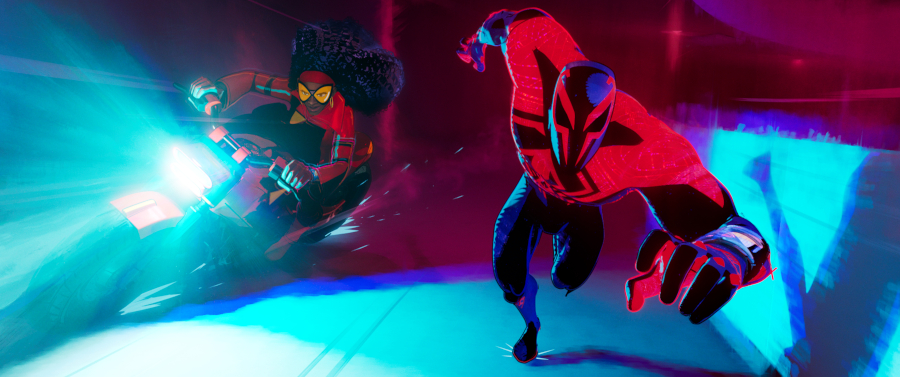
The lack of motion blur accents that style. “If you stop on any frame in the movie, it’s solid, sharp,” Dimian says. “In the ‘70s we had an effect where every frame was held, so we got a trail of previous images with traced-out lines. We have that kind of style. A non-blurred image that’s stepped behind another in the animation curve.”
Given the unique aesthetic and animation style, the team needed to find new ways to handle fast camera pans without using motion blur, and to create new types of lensing effects consistent with illustration, not realism. For a lensing effect, the team referenced old comic books, especially those with misprinted pages where the registration didn’t line up right. “We have the same image offset,” Dimian says. “It isn’t a blur. It isn’t out of focus. It’s an image with different colors offset based on z-depth, so it looks out of focus. But it feels natural because we use it consistently.”
Illustrated feel
“An illustrator can draw for emotion and completely contradict what the underlying geometry does, so we completely de-coupled the acting lines from the form, too,” Dimian says. “These acting lines can follow the form when we want them to, or break free when we want, and make expressions to just the camera view. So the lines work well in stereo, too.” The result gave animators new methods for creating facial performances for the 3D models. Rather than sculpting wrinkles, animators use these 2D acting lines to create expressions.
References
- How the ‘Spider-Verse’ Animators Created That Trippy Look - New York Times
- Best of 2023: How the “Spider-Man: Across the Spider-Verse” Visual Team Created a Mesmerizing Multiverse - Motion Picture Association
- Imageworks Artists ‘Break the Mold’ to Create an Alternate Spider-Verse - VFXV
- 6 Different Animation Styles In Spider-Man: Across The Spider-Verse Explained
